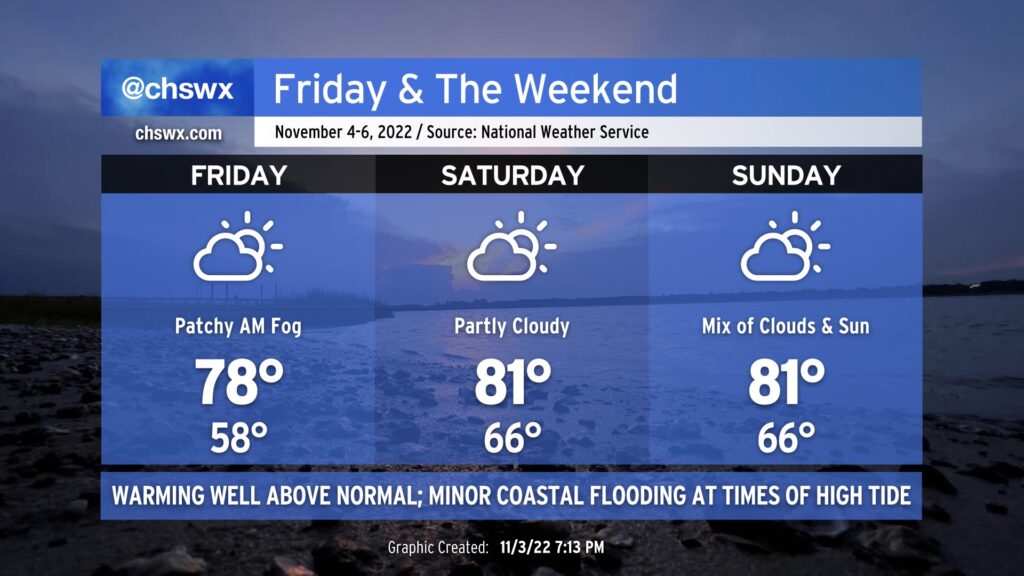
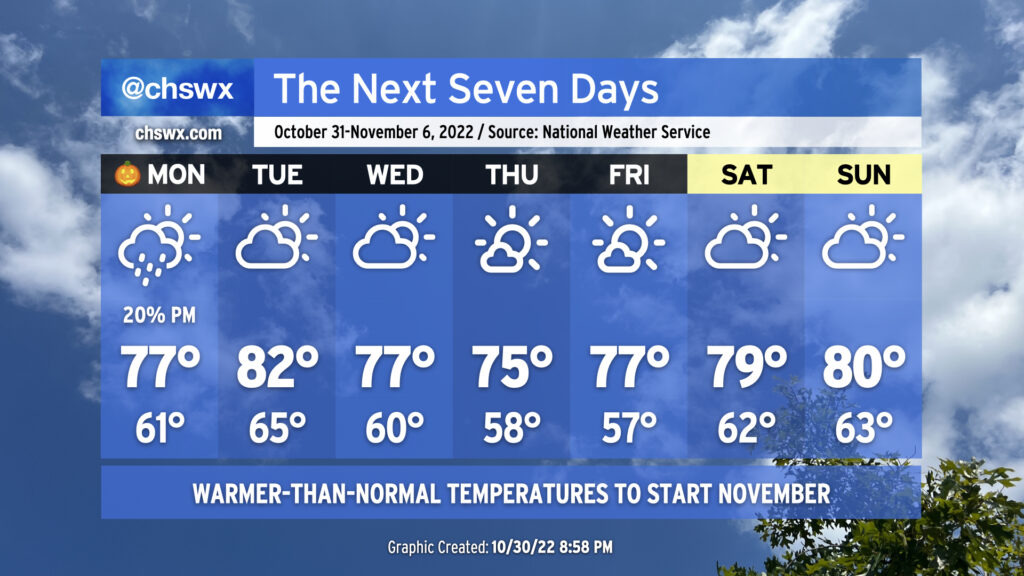
Even warmer weather is in the forecast for Friday and the weekend as high pressure at the surface slips offshore and winds turn southerly. Friday will still have a semblance of a fall feel, at least in the morning, as lows dip into the upper 50s ahead of highs in the upper 70s in the afternoon.
Thereafter, a more southerly component of wind begins to kick in, and we will begin to see temperatures (and humidity) kick up another notch. Saturday and Sunday will both start in the mid-60s — some 15° above normal — with highs reaching into the low 80s each afternoon. We’ll get close to record high minimums this weekend, but don’t anticipate breaching those. (The record high minimum for Saturday is 69°, and for Sunday is 71°, both set in 2003 during a record warm stretch.) Rainfall should be largely a non-issue, though a shower or two can’t be ruled out from time to time especially later this weekend as some upper energy interacts with a surface trough to our west.
The upcoming full moon and continued onshore flow will contribute to minor coastal flooding around times of high tide beginning Friday evening. More substantial coastal flooding will be possible as we head into next week as we watch for the potential for low pressure to develop in the western Atlantic, cranking the pressure gradient and northeasterly winds. This low could drive rain chances up in our neck of the woods as well, but the forecast extent of the rain still needs some finesse. Stay tuned this weekend for updates.
If you’re looking for a return to that fall feel that we had for a couple weeks in October, you may be waiting a little while: above-normal temperatures are favored through mid-month in the eastern third of the continental US. There are some signs that the pattern might change as we head toward Thanksgiving and beyond — stay tuned, though.
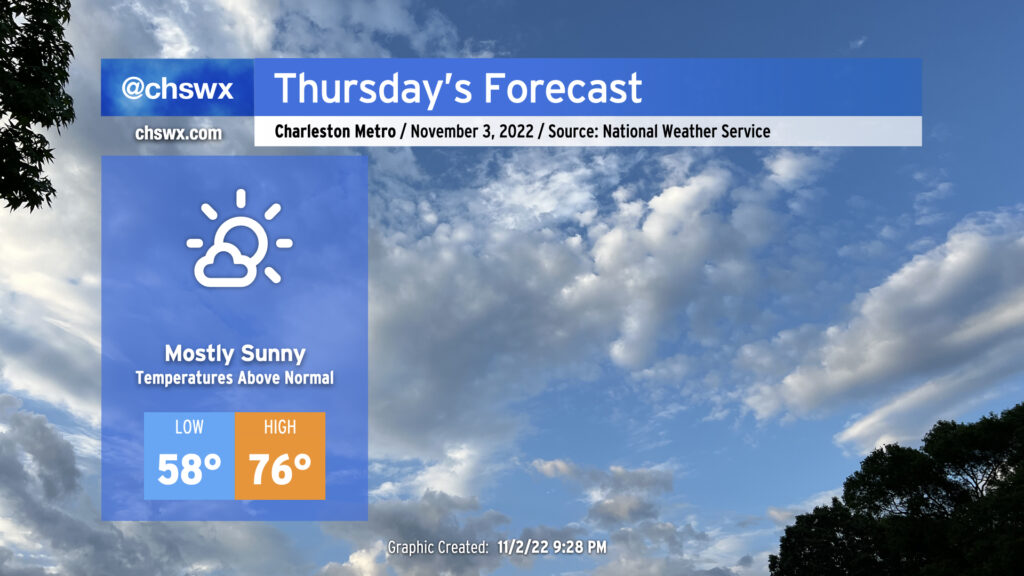
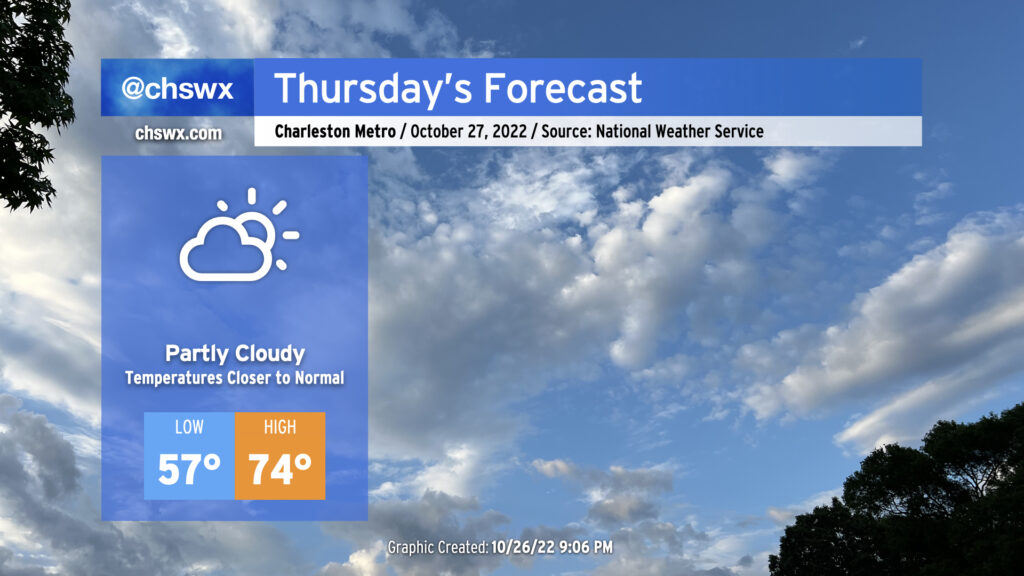
Weather’s looking good for Thursday as high pressure at the surface and aloft are in control. It will remain mild for November with temperatures running a few degrees above normal, especially in the morning. Expect plenty of sunshine with just a few passing clouds from time to time. If there’s one thing that might throw a fly in the ointment for an outdoors lunch, it’s that there will be a bit of a northeasterly breeze. Pin your napkins down appropriately and otherwise enjoy!
The only other weather concern will be the risk for some minor coastal flooding around the 5PM high tide. This could have commute impacts around Lockwood Dr. and the Citadel as salt water spills onto Fishburne and Hagood. If this is part of your evening commute, consider another route to avoid salt water splashing onto your car’s undercarriage.
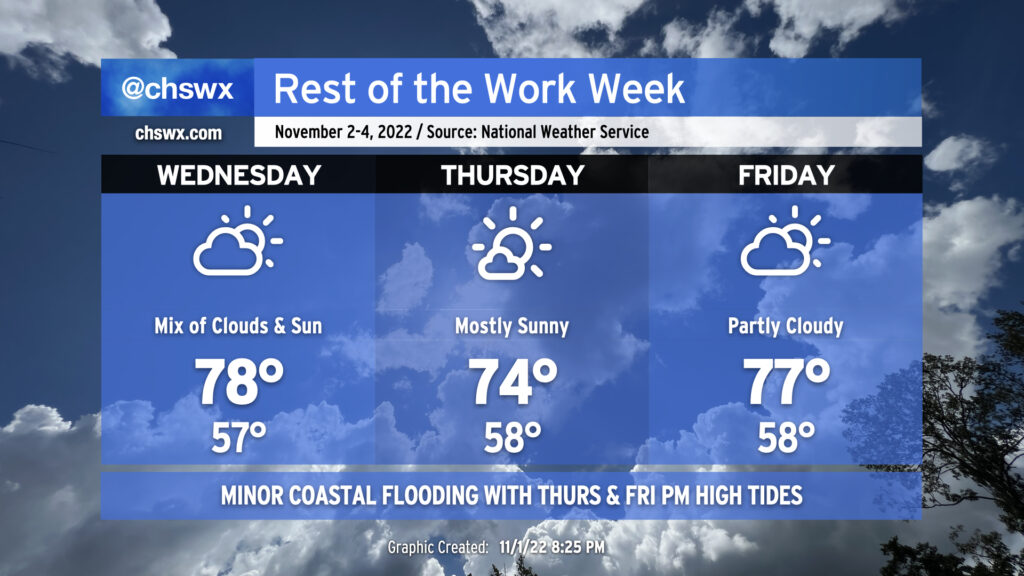
The weather will be generally quiet and comfortably warm for the rest of the work week, with temperatures running at or above normal for the foreseeable future as ridging develops in the Southeast. Northeasterly winds will keep temperatures generally in the mid-to-upper 70s each afternoon. Dewpoints in the 50s will generally be comfortable, though we should see those begin to creep back into the 60s starting Friday afternoon as moisture return inches up for the weekend.
The only hazard we’ll be watching for heading toward the weekend is the risk for minor coastal flooding with the afternoon and evening high tides, particularly Thursday and Friday, as persistent northeasterly wind and the approaching full moon (Nov 8) will combine to drive water levels over 7′. We could see evening high tides approaching moderate flood threshold by the weekend, so stay tuned for forecast updates.
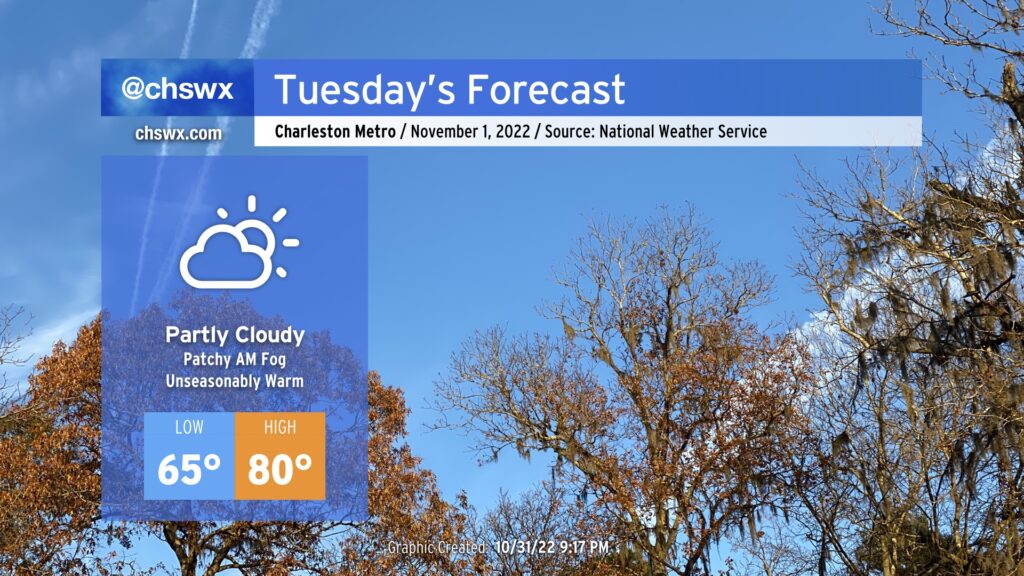
A cold front will push offshore Tuesday allowing dry high pressure to build into the area from the west. Before the front gets offshore, though, patches of fog — perhaps dense fog — will be possible in the morning as lows only bottom out in the mid-60s, a rather warm start to the first day of November.
Slightly cooler and drier air will filter into the area once the cold front has passed, but ridging aloft will help temperatures head to about 80° once again in the afternoon with ample sunshine peeking through scattered clouds. Rain-free conditions are expected.
We keep a rain-free forecast heading into the rest of the week, with more onshore flow helping to curb temperatures closer to normal especially as we head into Thursday and Friday. 80s look to return for the weekend before our next rain chance next Monday.
The week ahead will look a lot different from this past weekend as we cast away the gray in favor of more sunshine and warmer-than-normal temperatures to kick off November.
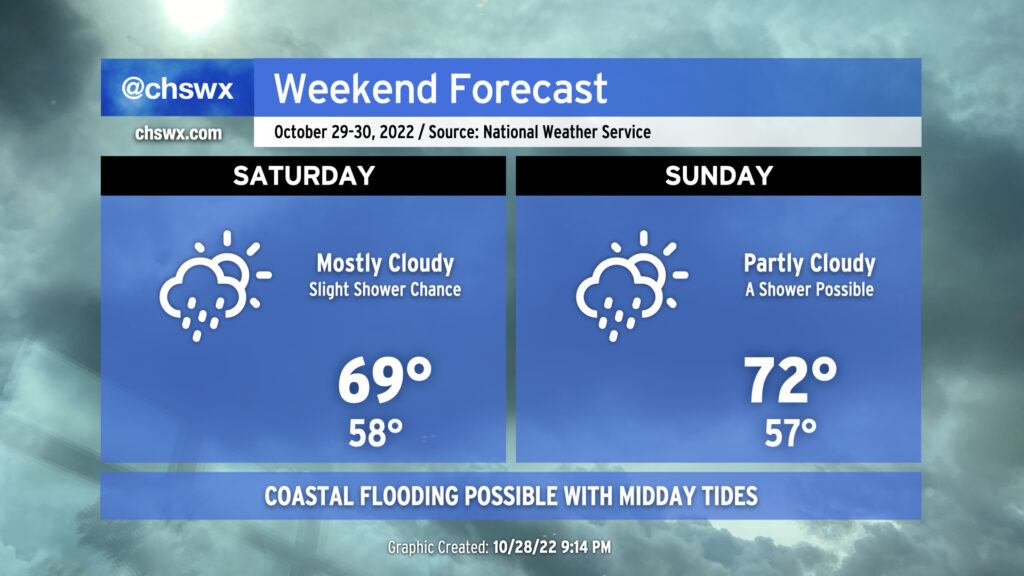
The weekend forecast will generally run on the cool side, particularly on Saturday, with a few showers possible at times. High pressure remains wedged into the area, and moisture trapped beneath the wedge inversion aloft will keep cloud cover and a few light showers in the forecast. Much like Friday, highs will likely not exceed 70° with the lack of insolation and cool northeasterly winds continuing to reinforce the wedge.
We should see a little bit more sunshine — and a little more warmth as a result — on Sunday as the wedge begins to erode. Still, a few showers will be possible at times, and one should not 100% trust the wedge to erode when it is supposed to.
Overall, you’ll want to have a hoodie or light jacket both days, and be ready to evade a few light showers, but it won’t be enough to cause major problems.
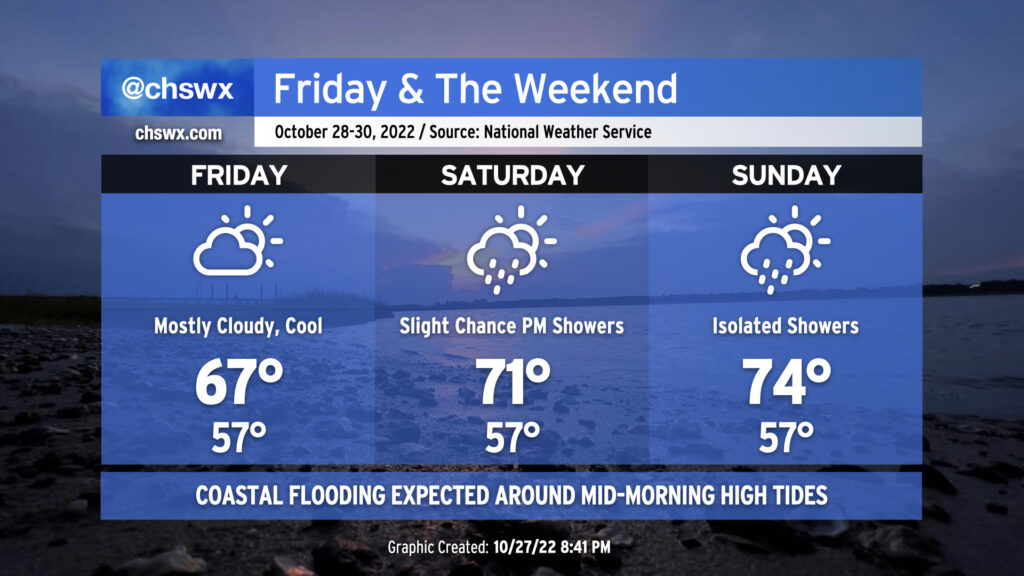
High pressure wedging into the area will keep clouds and cool temperatures around for Friday into the weekend. Temperatures shouldn’t get out of the 60s on Friday with a steady northeasterly breeze and mostly cloudy skies thanks to a thin layer of moisture being lifted atop the wedge. We could see a couple more breaks in the clouds on Saturday — along with a shower or two — as highs should creep above 70°. (Beware the wedge and its uncanny ability to bust temperature forecasts, though.) A warm front will sharpen and lift through the area on Sunday ahead of a cold front on Monday; this will help highs recover to the mid-70s in the afternoon. Moisture remains very shallow, but a shower or two can’t be totally ruled out in the evening hours.
The main weather hazard will continue to be coastal flooding thanks to continued astronomical influences from the lunar perigee and northeasterly winds. Friday morning’s high tide is expected to peak between 7.6-7.8′ in the harbor around 10:37am, which will be high enough to cause scattered road closures in downtown Charleston, particularly around the edges of the peninsula, a few hours on either side of that tide. Similar conditions are expected with Saturday morning’s high tide, forecast to peak a little after 11:30am. Water levels are expected to run a touch lower with the midday Sunday high tide, but should still be plenty high enough to produce minor to moderate coastal flooding, once again likely closing some roads. The good news is that any rain that falls won’t be very heavy at all, and won’t be enough to exacerbate any ongoing flooding.
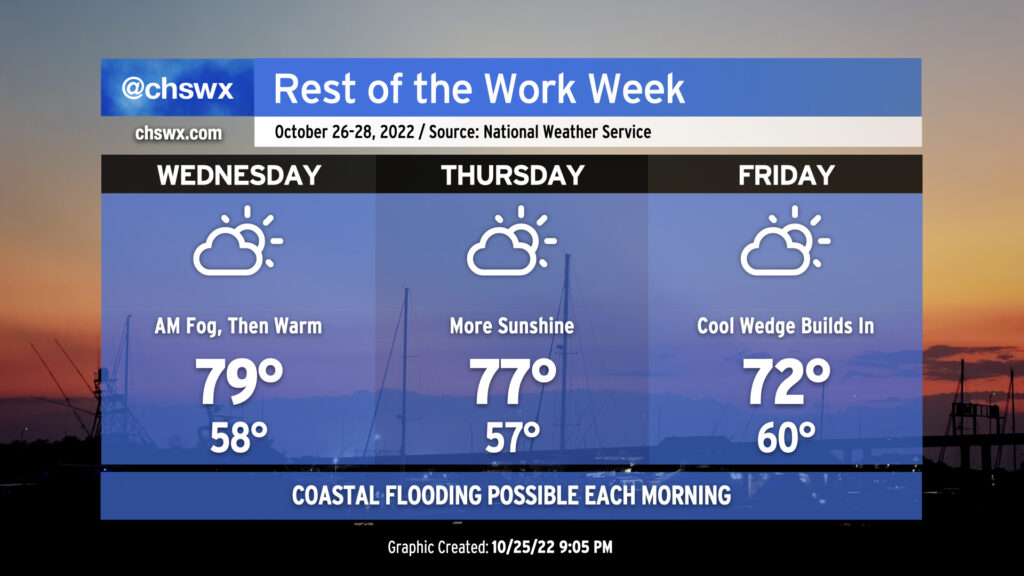
A cold front is on its way through this evening, which will bring cooler temperatures for Thursday and beyond after highs peaked in the low 80s this afternoon away from the locally cooler coastline. Winds will go to the north and then the northeast overnight as high pressure builds in from the north and west. We’ll generally see scattered clouds throughout the day with those northeast winds keeping us about 5-7° cooler than we saw Wednesday. The aforementioned northeasterly winds and upcoming lunar perigee will contribute to another risk for minor to moderate coastal flooding around the 9:47am high tide, so be aware of the potential for closed roads once again tomorrow morning (though the peak of any tidal flooding should miss the bulk of any commute time at this point).
We look to get off to another foggy start Wednesday morning, at least in spots, as temperatures bottom out just shy of 60° in the morning. We may not see quite the density nor the duration that we saw Tuesday morning, but still, be ready to use those low beams and allow extra time to get where you are going. Once any fog burns off, warm advection ahead of a cold front will help temperatures get to near 80° in the afternoon under partly cloudy skies.
The front gets through late Wednesday. It looks like it’ll get through mostly rain-free given limited moisture. Once that happens, winds will go around to the north and northeast and begin to bring some cooler air into the area. The persistent northeast winds will cool things down even further for Friday as highs only top out in the low 70s as cloud cover builds within a strengthening wedge of high pressure.